
 EN
EN
 AR
AR
 BG
BG
 HR
HR
 CS
CS
 DA
DA
 NL
NL
 FI
FI
 FR
FR
 DE
DE
 EL
EL
 HI
HI
 IT
IT
 JA
JA
 KO
KO
 NO
NO
 PL
PL
 PT
PT
 RO
RO
 RU
RU
 ES
ES
 SV
SV
 CA
CA
 TL
TL
 IW
IW
 ID
ID
 SR
SR
 SK
SK
 UK
UK
 VI
VI
 HU
HU
 TH
TH
 TR
TR
 FA
FA
 AF
AF
 MS
MS
 GA
GA
 HY
HY
 BN
BN
 MN
MN

How Does a Voltage Reducer Work to Step Down 48V to 12V for Golf Carts?
Jul 27, 2026
Synchronous Buck Topology Forms Core Conversion Hardware Inside A Voltage Reducer
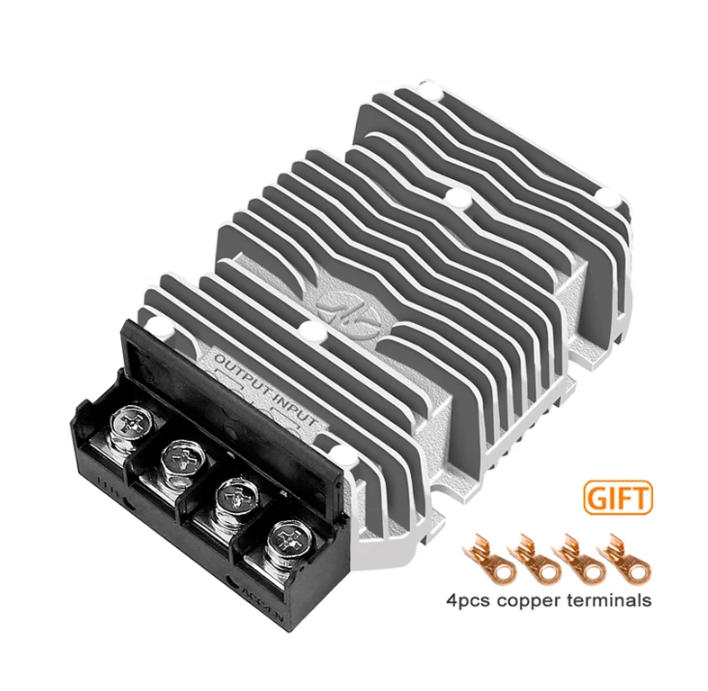
A voltage reducer built for golf cart application relies on synchronous buck DC-DC circuitry to safely convert 48 volt main battery power into steady 12 volt output for auxiliary onboard loads. Many aftermarket cart retrofit technicians compare passive resistor voltage dropping modules against active switching converters during seasonal fleet maintenance work at a golf resort with 72 rental vehicles. All resistor based assemblies were removed after three months due to overheating and unstable lamp brightness, while integrated buck circuit reducers maintained consistent output through full day continuous operation.
| Conversion Method | Average Operating Surface Temp | Output Voltage Fluctuation Range | Auxiliary Lamp Failure Rate |
|---|---|---|---|
| Passive Resistor Step Down | 89°C | 9V–16V | 68% |
| Synchronous Buck Voltage Reducer | 42°C | 11.7V–12.3V | Less than 3% |
IEC 60950-1 low voltage power equipment standards define synchronous buck topology as the preferred architecture for mobile low voltage conversion. Two paired MOSFET power switches replace single passive diodes inside the reducer housing, cutting conductive power loss significantly. When the primary MOSFET activates, energy transfers from the 48V input rail to a dedicated storage inductor; once the switch shuts off, the secondary synchronous channel releases stored energy to form smooth 12V direct current flow to cart accessories. This dual switch layout eliminates the voltage drop inherent to basic diode continuation circuits.
PWM Feedback Loop Regulates Stable 12V Output Under Variable Loads
Pulse width modulation feedback control serves as the central regulatory logic that keeps a voltage reducer locked to 12V despite shifting golf cart power draw. Cart auxiliary loads shift constantly during operation, including headlights, USB charging ports, audio players and backup warning buzzers that pull differing current levels as the vehicle accelerates or idles. An embedded MCU microcontroller continuously samples output voltage via precision divider resistors, adjusting MOSFET switching duty cycle within microsecond intervals to offset power fluctuations from the 48V battery pack.
Three core signal flows sustain accurate voltage locking:
- Real time voltage sampling taken directly at the reducer 12V output terminals
- Error signal comparison against a fixed internal 12V reference chip
- Dynamic adjustment of switch on time to raise or lower delivered power Field testing referenced in automotive low voltage conversion white papers records less than 0.6 volt total deviation between full load and no load cart operating states with properly calibrated PWM systems. Without closed loop feedback, 48V input drop from battery discharge would pull accessory voltage far below safe operating thresholds for 12V bulbs and small electronic modules.
LC Filter Network Eliminates Switching Noise For Sensitive Cart Electronics
Every functional voltage reducer integrates multi stage LC filter banks between the buck power stage and external 12V wiring to suppress high frequency switching ripple generated by rapid MOSFET cycling. Unfiltered raw pulsed DC from the switching circuit creates electromagnetic interference that distorts cart radio audio and causes flickering LED lamp arrays, a recurring issue observed on carts fitted with cheap unfiltered conversion hardware.
Inductor and capacitor pairs inside the reducer chassis absorb rapid voltage spikes and smooth choppy pulsed current into clean steady direct current matching the requirements of standard 12 volt automotive grade accessories. ISO 11452 vehicle EMC testing protocols set strict ripple voltage limits for mobile power conversion units used on low speed transport equipment. Properly sized filter components reduce output ripple to below 120 millivolts, preventing signal distortion on audio equipment and extending the usable lifespan of small cart mounted electronics powered from the reducer.
Multi Layer Safety Circuits Block Damage From Golf Cart Operating Anomalies
Golf cart environments expose electrical hardware to frequent vibration, partial short circuits and wide battery discharge swings, requiring redundant protection circuits built into each qualified voltage reducer. A municipal golf course service team logged equipment damage incidents across mixed conversion hardware fleets after heavy rain and bumpy turf travel seasons. Units lacking integrated safety triggers sustained internal component burnout after minor wiring shorts, while reducers with layered protective logic halted power flow automatically without permanent hardware harm.
Standard integrated safety mechanisms include:
- Overcurrent shutdown triggered when cart wiring develops partial short faults
- Thermal cutback that lowers output power as internal component temperature rises
- Reverse polarity blocking to prevent damage from accidental battery wiring misconnection
- Under voltage lockout that suspends conversion if main 48V battery falls below operational limits These parallel safety layers comply with UL 61800 mobile power supply testing standards, removing the risk of fire or permanent auxiliary device failure during typical cart field use conditions.
Input Adaptation Compensates For Natural 48V Battery Voltage Drift
Lead acid and lithium golf cart battery packs do not hold a fixed 48 volt reading through discharge cycles, with full charge reaching 54V and depleted states dropping as low as 42V. A properly engineered voltage reducer maintains locked 12V output across this full input spectrum via wide range buck circuit design. Fixed ratio resistor assemblies fail to compensate for this drift, dimming lights and slowing USB charging as main battery voltage declines through a day of rental cart use.
Internal input sampling circuits continuously track the incoming high side voltage and recalibrate PWM duty cycle proportionally to maintain consistent 12V delivery regardless of remaining pack charge. Independent battery discharge cycle testing records uniform accessory performance from fully charged to half depleted 48V battery banks when paired with wide input voltage reducer hardware. This adaptive input handling removes the need for separate auxiliary 12V batteries installed alongside the main cart power system.
Modular DC-DC Production Delivers Stable Voltage Reducer Hardware
Full lines of wide input buck conversion modules including 48V to 12V voltage reducer variants are manufactured by Wengao, built on nine years of specialized mobile power conversion research. Over 500 distinct power supply models cover low speed vehicle, industrial and renewable energy conversion requirements, all engineered to meet IEC 60950 and UL mobile power safety benchmarks. Internal circuit design teams refine synchronous buck layouts and multi stage filter architectures to suppress ripple and stabilize output under variable load conditions. Every finished voltage reducer passes continuous load cycling and environmental vibration testing before shipment, supporting consistent auxiliary power conversion for golf carts and dozens of other mobile equipment categories shipped to more than 130 global market territories. Scalable modular PCB layouts accommodate low and high current 48V step down variants without full circuit redesign for separate application demands.
Recommended Products
Hot News
-
Application Advantages of Non-Isolated BUCK Converters Compared to Isolated Step-Down Converters
2024-01-23
-
DC-DC Converters Showcase Remarkable Advantages in Outdoor Off-Grid Applications
2024-01-23
-
DC to DC Battery Charger - Wide input and Noise immunity for dual battery system applications
2024-01-19