 EN
EN
 AR
AR
 BG
BG
 HR
HR
 CS
CS
 DA
DA
 NL
NL
 FI
FI
 FR
FR
 DE
DE
 EL
EL
 HI
HI
 IT
IT
 JA
JA
 KO
KO
 NO
NO
 PL
PL
 PT
PT
 RO
RO
 RU
RU
 ES
ES
 SV
SV
 CA
CA
 TL
TL
 IW
IW
 ID
ID
 SR
SR
 SK
SK
 UK
UK
 VI
VI
 HU
HU
 TH
TH
 TR
TR
 FA
FA
 AF
AF
 MS
MS
 GA
GA
 HY
HY
 BN
BN
 MN
MN

How Does a 48V to 12V Converter Power Accessories in Electric Vehicles?
Jul 06, 2026
Real EV fleet cases show risks without qualified 48V to 12V conversion modules
Many commercial light hybrid fleet operators and electric camper remodelers share costly equipment failure experience after installing uncertified low quality voltage conversion parts. A regional logistics company deployed twenty mild hybrid delivery vehicles equipped with generic unregulated 48V to 12V modules two years ago. Within six months of daily urban delivery cycles, over half the vehicles presented flickering dashboard screens intermittent door lock failure and rapid 12V auxiliary battery discharge. Irregular output voltage from inferior converters created unstable power supply to onboard sensors and media hardware, triggering frequent vehicle fault codes and one to two hours of downtime per vehicle for inspection and replacement. Another independent electric RV modifier fitted cheap conversion units for cross country travel vehicles, reporting burnt water pump motors and broken USB charging ports after long hours of highway driving under high temperature cabin conditions. These real world fleet and private travel operation records fully prove that only vehicle grade standardized 48V to 12V converters can deliver consistent safe power to all 12V accessories, while unqualified conversion hardware generates continuous hidden maintenance expenses and operation interruptions.
Core buck topology logic of 48V to 12V converters for steady accessory power supply
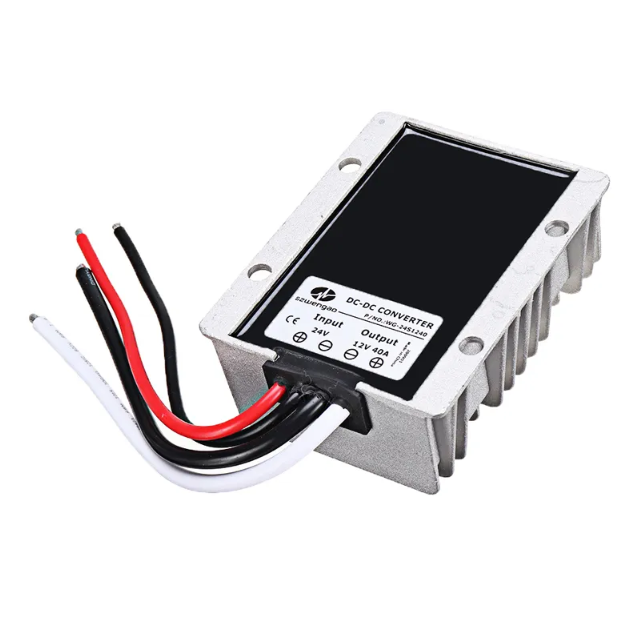
The core working mechanism enabling 48V battery packs to safely power all standard 12V EV accessories relies on mature buck DC DC topology controlled by precise pulse width modulation technology. When the converter receives fluctuating direct current from a vehicle’s 48V lithium battery system, internal MOSFET switches cycle on and off at high fixed frequencies to split input energy into controllable segments. Inductors inside the module store magnetic energy during switch conduction phases and release smooth stable current during cut off cycles, while multi stage capacitor filtering eliminates high frequency ripple interference that damages sensitive vehicle electronics. Isolated 48V to 12V models add internal transformer isolation layers to block high voltage surge transmission between the 48V main power loop and low voltage accessory circuits, an essential safety design for light hybrid and electric vehicle architecture. The whole conversion process locks output voltage within strict 12V rated tolerance ranges regardless of 48V input swings caused by acceleration braking or idle charging cycles, creating a constant power source matching the voltage requirement of every factory fitted and aftermarket vehicle accessory.
Global automotive electrical standards set authoritative design benchmarks for conversion equipment
Unified international vehicle electrical specifications release clear mandatory design rules for all 48V to 12V converters used in electric and mild hybrid vehicles, providing credible authoritative evaluation standards for equipment selection and production. ISO 21780 dedicated 48V road vehicle electrical requirement documents and European LV148 industry code both outline complete protection function checklists that every qualified conversion module must carry. Senior automotive electronic researchers publishing in global vehicle engineering journals state that certified vehicle grade converters need integrated over voltage over current over temperature and short circuit automatic cut off circuits to shield connected 12V accessories from abnormal power damage. Independent third party automotive testing laboratories implement multi cycle vibration thermal shock and humidity aging inspections to verify converter stability, with official test reports acting as trusted proof of compatibility with mass produced EV accessory systems. All standardized design parameters ensure the conversion hardware works safely alongside factory installed vehicle wiring harnesses and control units across all climate zones.
Full range vehicle accessory categories relying on 48V to 12V converted 12V power
Nearly all non high voltage auxiliary hardware fitted on modern electric vehicles draws operating power from the stable 12V output of a 48V to 12V converter, covering three major load groups with distinct electrical characteristics. The first group consists of driving safety and control accessories including instrument clusters body control modules door lock actuators rear view cameras and radar sensors, mostly low power capacitive loads sensitive to voltage fluctuation. The second group contains comfort and entertainment equipment such as central touch screens interior LED lighting audio systems USB charging hubs and seat heating pads, mixing resistive steady current loads and small inductive signal components. The third category covers mobile outdoor auxiliary accessories widely installed on modified electric campers and delivery fleets including water circulation pumps cooling fans portable refrigerators and external work lamps, all inductive loads generating large instantaneous startup current surges. Well engineered converters reserve sufficient instantaneous power margin to absorb peak current spikes without output voltage drop, guaranteeing all connected accessories maintain consistent operation simultaneously during full load vehicle running conditions.
Long term operational gains brought by standard vehicle grade 48V to 12V conversion solutions
Fleet managers and private electric vehicle owners gain continuous measurable economic benefits by equipping certified vehicle grade 48V to 12V converters rather than generic unregulated conversion hardware. Stable regulated 12V output extends the service life of auxiliary lead acid or lithium batteries by more than forty percent by eliminating irregular charging voltage fluctuations, cutting annual battery replacement expenditure significantly. Sensitive media screen sensor and pump accessories experience far fewer burnout failures, removing repeated spare part purchasing and labor repair costs throughout years of vehicle operation. Commercial delivery fleets running hundreds of hybrid vehicles also reduce unexpected delivery delay losses caused by electrical fault shutdowns, maintaining fixed daily operation schedules and client delivery commitments. Calculations based on multi year fleet maintenance data show the moderate extra initial cost of standard compliant converters can be fully recovered within twelve months through saved accessory and battery replacement fees, delivering steady profit advantages for both corporate fleets and individual electric vehicle users.
Comprehensive power supply R&D and manufacturing capacity supplies reliable EV conversion hardware
Stable supply of fully compliant vehicle grade 48V to 12V DC DC converters for electric vehicle accessory power systems relies on complete independent research and mass production infrastructure. Wengao holds nine years of professional power supply manufacturing experience with a product catalogue exceeding five hundred models covering isolated buck boost and buck boost conversion modules suitable for 48V light hybrid EV RV and marine power architectures. The brand’s dedicated engineering team develops conversion hardware fully matching ISO 21780 and LV148 automotive standards, supporting customized power rating isolation grade and environmental protection parameter adjustment according to client vehicle system design demands. Every finished converter undergoes full cycle vibration thermal and waterproof aging testing before shipment, with power products distributed to more than one hundred thirty countries across global automotive and mobile equipment markets. Integrated one stop power solution service combines technical load analysis customized converter parameter tuning and global after sales spare part support, providing matched 48V to 12V power conversion hardware for mass produced mild hybrid passenger cars commercial delivery fleets and custom built electric camper vehicles with complex multi accessory electrical layouts.
Recommended Products
Hot News
-
Application Advantages of Non-Isolated BUCK Converters Compared to Isolated Step-Down Converters
2024-01-23
-
DC-DC Converters Showcase Remarkable Advantages in Outdoor Off-Grid Applications
2024-01-23
-
DC to DC Battery Charger - Wide input and Noise immunity for dual battery system applications
2024-01-19