 EN
EN
 AR
AR
 BG
BG
 HR
HR
 CS
CS
 DA
DA
 NL
NL
 FI
FI
 FR
FR
 DE
DE
 EL
EL
 HI
HI
 IT
IT
 JA
JA
 KO
KO
 NO
NO
 PL
PL
 PT
PT
 RO
RO
 RU
RU
 ES
ES
 SV
SV
 CA
CA
 TL
TL
 IW
IW
 ID
ID
 SR
SR
 SK
SK
 UK
UK
 VI
VI
 HU
HU
 TH
TH
 TR
TR
 FA
FA
 AF
AF
 MS
MS
 GA
GA
 HY
HY
 BN
BN
 MN
MN

DC to DC Smart Charger Analysis: Value and Scalability
The Dual-Battery Challenge and the Limits of Basic Charging
A dual-battery system looks straightforward on paper. The vehicle's alternator charges the starting battery, and a connection of some kind, a solenoid, a relay, a battery isolator, also routes charging current to an auxiliary battery that powers the living quarters, the work lights, the communication gear, or the hydraulic pump. The reality of how that auxiliary battery fares over time tells a less straightforward story. The starting battery lives an easy life. It delivers a large current for a few seconds to crank the engine, and then it is immediately recharged by the alternator and maintained at a full state of charge for its entire service life. The auxiliary battery lives a much harder life. It is deeply discharged over hours or days, running refrigerators, inverters, computers, and tool chargers, and then it is asked to recharge from a charging source that was designed to top up a nearly full starting battery, not to recover a deeply discharged deep-cycle battery. A standard alternator regulated to a fixed voltage, typically in the mid-fourteen-volt range, is a blunt instrument for battery charging. It supplies a constant voltage, and the battery draws whatever current its internal resistance allows. There is no awareness of the battery's state of charge, no adjustment for temperature, and no transition to a lower maintenance voltage once the battery is full. The result, over months and years of cycling, is an auxiliary battery that is chronically undercharged, slowly accumulating sulfate crystals on its lead plates that harden and permanently reduce its capacity. A DC to DC smart charger replaces this blunt instrument with an intelligent charging system that manages the charging process from start to finish, adapting its output to the battery's chemistry, temperature, and state of charge.
Multi-Stage Charging and the Intelligence That Protects Battery Life
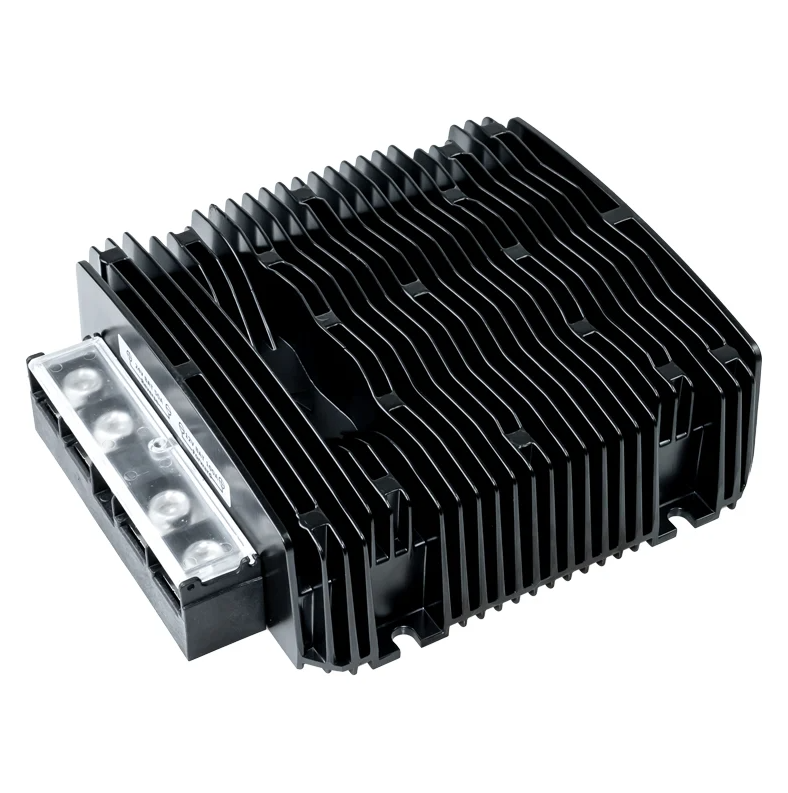
A DC to DC smart charger earns its name through the charging algorithm that runs inside its microcontroller. This algorithm breaks the charging process into distinct stages, each with a specific voltage and current target, and the charger transitions between these stages based on real-time measurements of the battery's voltage and current acceptance. The bulk stage is the workhorse phase. The charger delivers its maximum rated current to the battery, and the battery voltage rises steadily as it absorbs energy. This stage continues until the battery voltage reaches a preset absorption threshold, at which point the battery is typically at a high state of charge, though not yet completely full. The absorption stage holds the voltage constant at this elevated level while the battery's current acceptance gradually declines. This is the phase that completes the charge, driving energy into the deepest reaches of the battery's plates. A basic alternator connection or a relay-based split-charge system never reaches this stage properly because it lacks the voltage control precision and the timer logic to hold the absorption voltage for the required duration. The float stage is the maintenance phase. The charger reduces its output voltage to a level that counteracts the battery's natural self-discharge without overcharging it. The battery can remain connected to the charger in float mode indefinitely without damage. The significance of this multi-stage approach is not in the complexity for its own sake. It is in the battery lifespan extension that results from a battery receiving a complete charge every cycle rather than a partial charge that leaves it progressively more depleted over time.
Battery Chemistry Selectivity and the Value of Adaptive Profiles
A charging voltage that is correct for a flooded lead-acid battery will undercharge an absorbed glass mat battery and dangerously overcharge a lithium iron phosphate battery. The voltage setpoints that define the bulk, absorption, and float stages differ substantially between battery chemistries, and applying the wrong profile is a reliable method of shortening a battery's useful life. A smart charger addresses this through user-selectable or automatically detected battery chemistry profiles. The lead-acid family, flooded, AGM, and gel, shares broadly similar voltage requirements but with meaningful differences. A gel battery requires a lower absorption voltage than a flooded battery because its sealed construction cannot tolerate the off-gassing that occurs at higher voltages. An AGM battery, with its low internal resistance, can accept higher charge currents but still requires precise voltage control to prevent thermal runaway. Lithium iron phosphate batteries, increasingly common in auxiliary power applications due to their weight savings and deep discharge tolerance, operate on a fundamentally different charging philosophy. They require a higher bulk voltage, they do not need an absorption stage in the same way lead-acid batteries do, and they should not be held at a float voltage once fully charged because continuous float charging degrades their cell chemistry. A smart charger with a dedicated lithium profile implements these requirements correctly. The temperature compensation function adds another layer of adaptive intelligence. A lead-acid battery's ideal charging voltage decreases as temperature rises and increases as temperature falls. A charger with a temperature sensor, either internal or connected to the battery terminal, adjusts the charging voltage in real time to prevent undercharging in cold weather and overcharging in hot weather.
The Scalability Argument and Building a Coherent Power System
A single smart charger operating in isolation solves a single charging problem. The broader value proposition of smart charging technology becomes apparent when the system scales and multiple charging sources, multiple battery banks, and varying load demands must be coordinated. In a recreational vehicle with solar panels on the roof, a DC to DC charger connected to the alternator, and a shore power charger connected to the grid, the auxiliary battery can receive charging current from three distinct sources. A smart charging architecture coordinates these inputs, typically by designating a primary charge controller that manages the battery's state of charge while other sources either contribute or disconnect based on voltage thresholds. The charger's ability to function within a larger system without conflicting with other charge sources is a key scalability feature. In a commercial fleet application, where multiple vehicles operate with identical auxiliary power configurations, the smart charger enables a standardized, repeatable power system design. Every vehicle in the fleet receives the same charging profile, the same battery protection logic, and the same predictable performance. Maintenance is simplified because battery health is consistent across the fleet, and battery replacement intervals become predictable rather than reactive. For a system designer or a fleet manager, this scalability translates into a coherent power architecture rather than a collection of individual chargers each operating on their own assumptions.
Operational Value and the Total Cost of Ownership Perspective
The value of a DC to DC smart charger becomes clearest when viewed through the lens of total cost of ownership rather than unit purchase price. A basic split-charge relay costs less to acquire than a smart charger. The cost difference is visible on the invoice. The operational costs that follow are less visible but far more significant. A deep-cycle auxiliary battery that is chronically undercharged by a basic charging system will fail prematurely, often in half the time or less of its rated cycle life. The cost of replacing that battery, including the labor to remove the old unit and install the new one, the downtime of the vehicle or system while the battery is being replaced, and the collateral frustration of unreliable power, easily exceeds the initial price difference between a relay and a smart charger. Beyond battery replacement costs, the operational value of predictable power availability is difficult to quantify but impossible to ignore. A work truck whose auxiliary battery reliably powers the inverter for the full workday, an RV whose house battery runs the refrigerator through the night without the low-voltage alarm sounding at dawn, and a communication shelter whose batteries maintain their capacity through a multi-day deployment all deliver their intended function without interruption. That reliability is the operational return on the smart charger investment. The charger pays for itself over time through avoided battery replacements and avoided service disruptions.
Manufacturing Integrity and the Supply Chain Behind Reliable Smart Charging
A DC to DC smart charger is a power electronics device that operates in environments hostile to electronics. Vibration, temperature extremes, dust, and moisture are not occasional hazards. They are the normal operating conditions in an engine bay, a battery compartment, or an equipment enclosure. The charger's ability to deliver its specified charging algorithm reliably over years of service depends on the quality of its design and manufacturing. The microcontroller that runs the charging algorithm must be protected from electrical noise conducted through the vehicle's wiring. The power transistors that handle the high-frequency switching must be adequately heatsinked and thermally managed. The input and output terminals must be robust enough to maintain low-resistance connections despite vibration and thermal cycling. The conformal coating on the printed circuit board must be applied uniformly to protect against moisture and contaminant ingress. RCNUN manufactures DC to DC smart chargers with attention to these environmental and reliability requirements, building units where the circuit design, component selection, and assembly quality reflect the real-world conditions in which the chargers will operate. For a system integrator specifying components for a fleet deployment, an off-grid installation, or a commercial vehicle upfit, the charger's manufacturing integrity translates into predictable field performance. A charger that consistently executes its multi-stage profile, correctly identifies the battery chemistry, and protects itself and the battery against fault conditions is a charger that the integrator can specify with confidence across multiple installations. The technology inside the charger, the adaptive algorithm, the chemistry selectivity, the protection features, delivers its value only if the hardware that contains it is built to survive. That combination of intelligent design and robust manufacturing is what defines a smart charger as a system component rather than a disposable accessory.
Recommended Products
Hot News
-
Application Advantages of Non-Isolated BUCK Converters Compared to Isolated Step-Down Converters
2024-01-23
-
DC-DC Converters Showcase Remarkable Advantages in Outdoor Off-Grid Applications
2024-01-23
-
DC to DC Battery Charger - Wide input and Noise immunity for dual battery system applications
2024-01-19