
 EN
EN
 AR
AR
 BG
BG
 HR
HR
 CS
CS
 DA
DA
 NL
NL
 FI
FI
 FR
FR
 DE
DE
 EL
EL
 HI
HI
 IT
IT
 JA
JA
 KO
KO
 NO
NO
 PL
PL
 PT
PT
 RO
RO
 RU
RU
 ES
ES
 SV
SV
 CA
CA
 TL
TL
 IW
IW
 ID
ID
 SR
SR
 SK
SK
 UK
UK
 VI
VI
 HU
HU
 TH
TH
 TR
TR
 FA
FA
 AF
AF
 MS
MS
 GA
GA
 HY
HY
 BN
BN
 MN
MN

A Reliable Marine Battery Charger Ensures Your Boat Is Always Ready for Adventure.
A Morning on the Water That Almost Never Happened
I remember helping a neighbor prep his center console boat for an early morning fishing trip. The gear was loaded, the bait was cold, and the sky was just beginning to glow orange. He turned the ignition key, and nothing happened except a weak clicking sound from the engine compartment. The battery was dead. Not weak, completely flat. He had plugged in his old charger the night before, and the status light showed green, falsely indicating a full charge. That charger had failed to detect the battery actual state of health and simply shut off early. We missed the tide and the trip was ruined. This scenario plays out at marinas everywhere, and it underscores a fundamental truth: a marine battery charger is not just an accessory. It is a lifeline. If the charger cannot accurately read, condition, and maintain your batteries while you are away, your boat is nothing more than a floating liability.
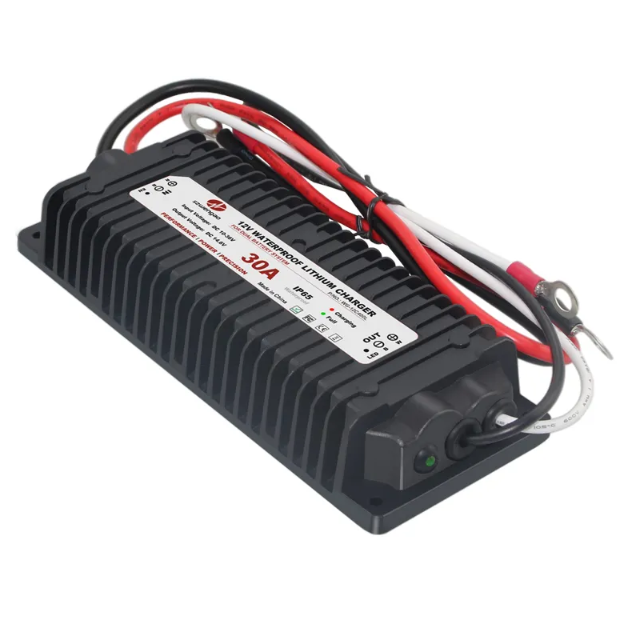
Matching Charger Intelligence to Your Battery Type
Modern boats use an array of battery chemistries. You may find traditional flooded lead acid starting batteries paired with deep cycle AGM house banks, or you might have upgraded to lithium iron phosphate for weight savings and fast charging. Each chemistry demands a specific voltage curve and a unique charging algorithm. A flooded battery requires a periodic equalization phase to stir the electrolyte, while a sealed AGM battery will be destroyed by that same high voltage spike. Lithium batteries need a constant current constant voltage profile with precise termination, never a float charge. A truly reliable charger integrates configurable dip switches or auto detection circuits, and also uses a temperature sensor attached to the battery case to adjust voltage in real time. Without temperature compensation, a charger pushing 14.4 volts in the cool morning might deliver the same voltage in a hot engine bay, cooking the electrolyte. Real expertise lies in designing a charger that protects against sulfation without overcharging, a balance that separates marine grade equipment from an automotive trickle charger tossed in the bilge.
Safety Standards That Keep the Water Out and the Fire Away
When you install a charger in the confined space of a boat, safety is not negotiable. The American Boat and Yacht Council publishes standard ABYC A 31, which details requirements for battery chargers, including ignition protection for use in gasoline engine compartments. A charger must not emit sparks that could ignite fuel vapors. UL 1236 and marine specific listings also require robust isolation between the AC input and DC output to prevent galvanic corrosion and electric shock risks. I once spoke with a certified marine surveyor who told me that the most common electrical deficiency he notes during pre purchase surveys is improperly secured chargers lacking ignition protection. He stressed that a good charger should be built with conformal coated circuit boards, sealed connections, and stainless steel hardware to endure salt laden humidity. When a manufacturer invests in these certifications and materials, it demonstrates a commitment to protecting not just the battery, but the boat and everyone on board.
The Real Cost of a Cheap Charger Is Not on the Price Tag
It is easy to be tempted by a low cost charger that claims to do everything. But the true cost calculation should span five years or more. A poorly regulated charger can slowly sulfate a premium AGM battery, reducing its capacity by 30 percent within a single season. You then face an unexpected battery replacement bill of several hundred dollars, plus the hassle of disposal. Worse, during a weekend cruise, a failed charger might leave you with dead house batteries, meaning no navigation lights, no radio, and no bilge pump. The expense of a tow back to the marina and emergency repairs quickly surpasses any initial savings. From a business perspective, charter operators and fishing guides rely on dependable power every single day. Downtime equals lost revenue and damaged reputation. A reliable charger, priced reasonably and built to last, is an investment that pays for itself through years of trouble free starts and extended battery life.
Reliability Is Built Before It Is Installed
At the end of the day, charger reliability is manufactured on the factory floor, long before it is mounted on a bulkhead. It comes from selecting genuine semiconductor components, oversizing heat sinks, and applying full load burn in tests on every unit. It comes from a supply chain that rejects substandard magnetics and insists on high frequency toroidal transformers that run cool. Wengao Electronics has built its reputation by applying this disciplined approach to power conversion products. With vertically integrated manufacturing and a rigorous quality management system, Wengao Electronics ensures that each marine charger leaving the facility meets precise electrical specifications and environmental durability standards. For boat builders, distributors, and fleet operators seeking a partner capable of delivering consistent performance at scale, this level of manufacturing integrity provides the confidence that every adventure will start with a fully charged battery and the simple turn of a key.
Recommended Products
Hot News
-
Application Advantages of Non-Isolated BUCK Converters Compared to Isolated Step-Down Converters
2024-01-23
-
DC-DC Converters Showcase Remarkable Advantages in Outdoor Off-Grid Applications
2024-01-23
-
DC to DC Battery Charger - Wide input and Noise immunity for dual battery system applications
2024-01-19